
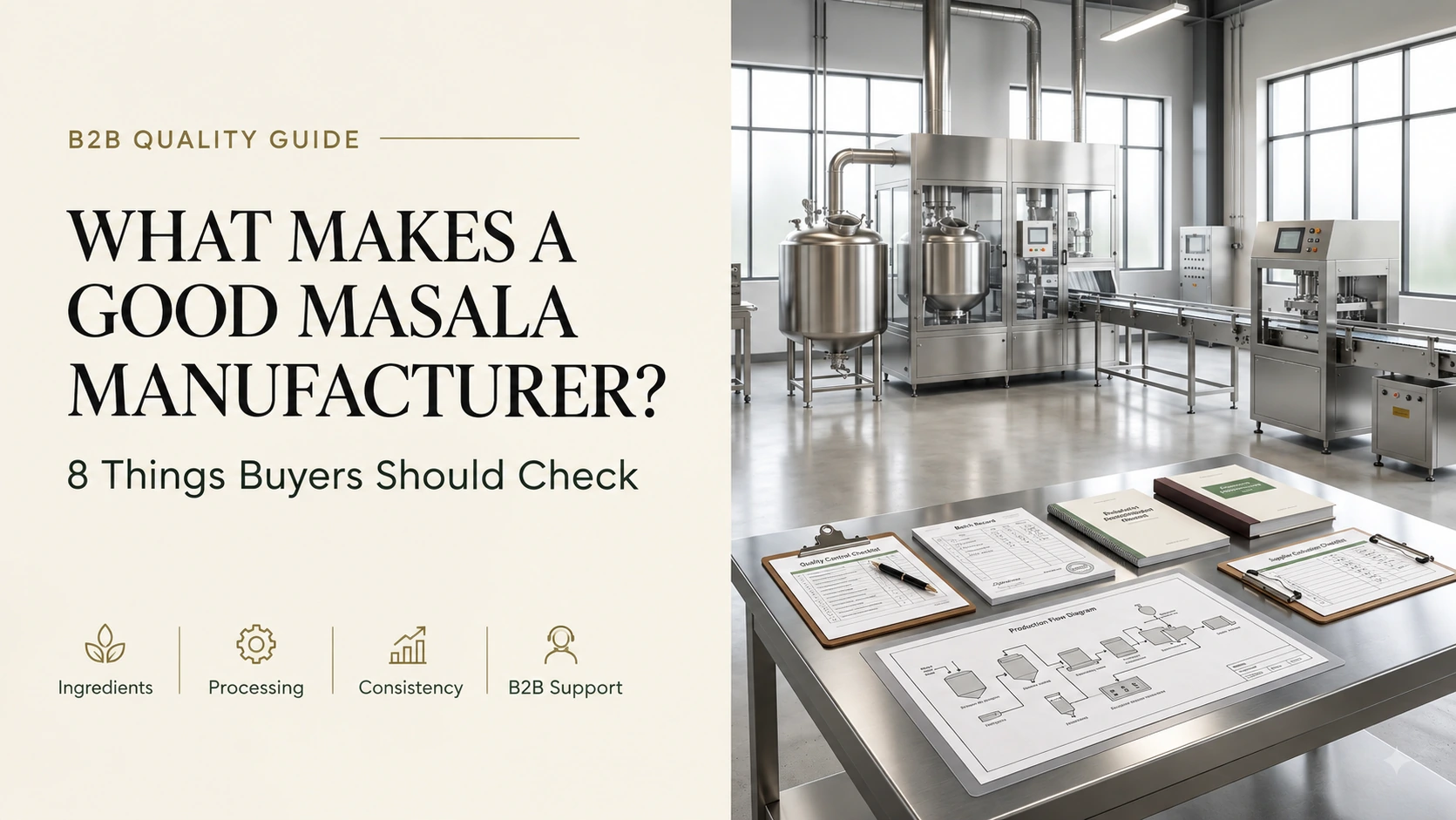
Choosing a masala manufacturer is a business decision, not only a taste test. Restaurants, retailers, distributors, caterers, hotels and other food businesses need a spice manufacturer whose products, pack formats and communication fit the way they buy and sell. This guide gives buyers a practical framework for comparing suppliers without relying on vague promises.
What should you look for in a masala manufacturer?
A good masala manufacturer should make its product range and intended use clear, explain how it approaches ingredient selection and processing, offer formats that suit the buyer’s operation, and communicate consistently about batches and support. Buyers should check eight areas: product fit, ingredient approach, processing, blend method, consistency, packaging and pack size, B2B suitability, and accessible business communication. The right choice is the supplier that can answer these questions clearly and match the answer to your day-to-day requirements.
These checks are useful when comparing suppliers serving Chennai and Tamil Nadu. A retailer may need consumer packs, while a hotel or caterer may need institutional formats. A distributor may need a catalogue that is easy to understand. Evaluate operating fit before discussing a long-term relationship.
1. Does the spice manufacturer have the products your business actually needs?
Start with the range, not the brand name. A supplier should cover the products relevant to your menu, shelf, or distribution plan. HIPA Masala presents pure single spice powders alongside traditional South Indian blends. Its listed range includes Sambar Powder, Rasam Powder, Turmeric Powder, Red Chilli Powder, Coriander Powder, Cumin Powder, Pepper Powder and Garam Masala.
Review the complete HIPA Masala product range and map each product to a real business need. A restaurant or caterer may begin with Sambar Powder and Rasam Powder. A retailer may prefer a combination of everyday single spices and blends. A distributor should consider whether the range is understandable enough to present to different customer types.
2. Can the masala manufacturer explain its ingredient approach?
Ingredient language should be specific enough for a buyer to understand what the product is intended to contain and how it is positioned. HIPA Masala describes an approach based on selected whole spices. It also states that its products use zero artificial dyes, chemical preservatives and synthetic flavour enhancers. Treat this as HIPA’s stated product approach, rather than as an independent audit or a guarantee for every buyer’s application.
Compare the product information with your purchasing requirements. If you are buying Turmeric Powder, Red Chilli Powder or Coriander Powder, ask how each product fits your recipes, customer expectations and internal specifications. Keep clear which points are stated and which still need confirmation.
3. Does the spice manufacturer describe a controlled processing method?
Processing affects how a spice product is made and how consistently a supplier can explain its production approach. HIPA Masala describes controlled low-temperature milling for its powders. This is a description of HIPA’s stated approach; it should not be rewritten as an independently verified performance claim.
Ask a prospective supplier to explain its method in plain language. You need enough information to understand whether the process is deliberate, repeatable and suited to your expectations. Record the answer alongside pack size, product name and proposed use so different suppliers are compared on the same basis.
4. Are traditional blends handled as blends, not just as generic powder?
A blend has a different buying question from a single spice. For a traditional South Indian blend, the balance of ingredients and the way they are prepared can matter to the recipe and the buyer’s consistency expectations. HIPA Masala states that it slow-roasts whole spices and lentils for its blends.
This is relevant when you compare products such as Garam Masala with single-spice powders. Ask which products are blends, how the supplier describes their preparation, and whether your team can evaluate the flavour in the dishes where it will be used.
5. Can the masala manufacturer support consistency in repeat buying?
Business buyers usually need a product that can be reordered with a clear expectation of what they are buying. HIPA Masala describes batch consistency as part of its approach. Again, this is HIPA’s stated approach and not an independent verification. The useful commercial question is how the supplier communicates about repeat orders and how your business can review the product against its own requirements.
Before a recurring purchase, define a simple internal check. Compare product name, pack format, appearance, aroma, taste in the intended recipe and delivery condition. Keep notes from the first order so a later review can discuss specific observations rather than memory. This discipline works for any masala manufacturer, from a small restaurant to a larger distributor.
6. Do pack formats match your sales or kitchen workflow?
Pack size is part of supplier fit. HIPA Masala describes formats ranging from household packs through 500g and 1kg institutional packs. That range can be relevant to buyers with different operating models, but each business should still confirm the format it needs before placing an order.
Retailers and supermarkets can assess whether consumer formats fit their shelf plan. Restaurants, hotels and caterers can check whether institutional formats suit storage, kitchen usage and stock rotation. Distributors should consider which formats are easiest to present. The goal is not the largest pack; it is a format that supports sensible handling and replenishment.
- Retail: check whether the range and household-oriented packs are easy to merchandise.
- Food service: check whether 500g or 1kg institutional packs fit actual consumption and storage routines.
- Distribution: check whether each product and format can be explained clearly to downstream buyers.
7. Does the spice manufacturer understand B2B buyers?
A supplier serving business buyers should make it easy to begin a relevant conversation. HIPA Masala describes B2B support for retailers, supermarkets, distributors, restaurants, hotels and caterers. The HIPA Masala B2B enquiries page is the appropriate starting point for a buyer who wants to discuss business requirements.
Use the first conversation to share your business type, products under consideration, approximate use or resale context, preferred formats and questions your purchasing team must resolve. A catalogue may not answer every operational question, so identify what is available and what needs confirmation.
8. Can you verify who you are buying from and reach them easily?
Traceable business information matters when a purchase may become recurring. HIPA Masala is an Indian spice brand owned and operated by HIPA Enterprises in Pallavaram, Chennai. Its stated business address is Plot No. 10, (Highway Colony), 5th Main Road, Zamin Pallavaram, Highway Nagar, Perumal Nagar, Old Pallavaram, Chennai – 600117, Tamil Nadu, India. The published contact details are +91 70580 53055 and info@hipamasalas.com.
Learn more through the HIPA Masala company information page, then use the HIPA Masala contact page for direct communication. Accessibility does not prove product suitability, but it gives buyers a route to ask questions and document the conversation.
A quick comparison checklist for business buyers
Use this checklist when comparing a masala manufacturer or spice manufacturer. Mark each item “clear,” “needs confirmation” or “not a fit.” This keeps the decision practical.
| Check | Buyer question | What to record |
|---|---|---|
| Range | Does the catalogue cover our recipes, shelf plan or customer needs? | Relevant single spices and blends |
| Approach | How does the supplier describe ingredients and processing? | Stated approach and open questions |
| Formats | Are the pack sizes practical for resale, storage and usage? | Required pack size and use case |
| Repeat buying | How will our team review consistency across orders? | Internal product checks and notes |
| Support | Can we reach a clear business contact with follow-up questions? | Contact route and response items |
Explore HIPA Masala products for your business
Compare products in the context where they will be used. Buyers can review Cumin Powder and Pepper Powder as single spice options, then consider the wider range. Base the decision on product fit, stated manufacturing approach, pack format and business discussion—not an exaggerated guarantee.
For Chennai and Tamil Nadu businesses looking for a local point of contact, visit the HIPA Masala website to review the brand and its products. If you are ready to discuss a business requirement, use the B2B enquiry route and provide enough detail for a useful response.
Frequently asked questions
What is the most important check when choosing a masala manufacturer?
Start with product fit. Confirm that the supplier has the single spices or blends your business genuinely needs, then assess processing, pack formats, consistency and communication.
Is a larger pack always better for a restaurant or caterer?
No. The suitable format depends on consumption, storage and stock rotation. HIPA Masala describes 500g and 1kg institutional formats, but each buyer should confirm which format fits its workflow.
How should buyers interpret a supplier’s manufacturing claims?
Read them as the supplier’s stated approach unless you have independently verified supporting evidence. Ask focused questions and compare the answers with your own purchasing requirements.
Conclusion: choose a masala manufacturer you can evaluate clearly
A good masala manufacturer is not defined by one slogan. Examine the range, ingredient approach, processing description, blend method, batch-consistency approach, pack formats, B2B support and business contact details. For a Chennai or Tamil Nadu food business, these checks create a more useful comparison.
HIPA Masala presents pure single spice powders and traditional South Indian blends, with product formats and B2B support described for different business needs. Review the stated information, identify what your team still needs to confirm, and contact HIPA Masala with your specific requirement before making a purchasing decision.