
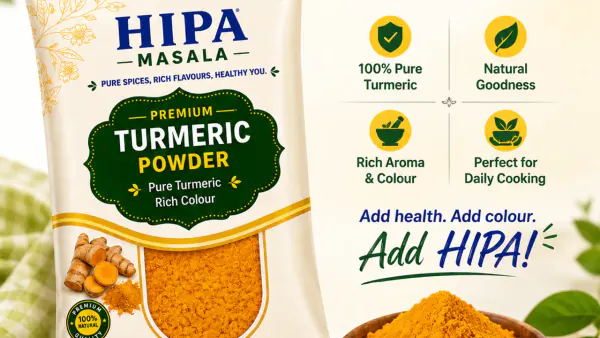
Turmeric is revered across India not only as an essential culinary colourant but as a daily health staple. Its characteristic golden hue and wellness properties are driven by curcumin, a natural polyphenol found in mature turmeric rhizomes.
However, commercial turmeric powders are frequently adulterated with cheap extenders like chalk, corn starch, saw dust, and dangerous non-permitted chemical dyes such as metanil yellow and lead chromate.
Here are four simple, verified home tests you can run in your kitchen to verify your turmeric powder's authenticity.
Test 1: The Glass of Warm Water Test
This is the easiest and most reliable test for everyday kitchen detection:
1. Fill a clear glass with warm water. 2. Drop 1 teaspoon of turmeric powder onto the water surface without stirring. 3. Observe the settling behavior for 15–20 minutes: - Pure Turmeric: Slowly and naturally settles down to the bottom of the glass. The water above remains clear or pale, light yellow. - Adulterated Turmeric: Stays cloudy, milky, or turns a harsh neon yellow, indicating water-soluble synthetic dyes or chalk suspensions.
Test 2: The Hydrochloric Acid / Lemon Juice Chemical Test
Metanil yellow is a carcinogenic synthetic dye banned in food processing under FSSAI regulations.
- Put a small pinch of turmeric in a shallow white dish.
- Add a few drops of concentrated acid (or fresh lime juice / clear vinegar).
- If the mixture instantly turns a vivid magenta or violet that remains intense even after adding water, synthetic chemical dyes are present. Pure turmeric will remain yellow or turn a natural deep amber.
Test 3: The Palm Rubbing & Staining Texture Test
- Take a small pinch of turmeric on the palm of your left hand.
- Rub it firmly with your right thumb for 20 seconds.
- Pure ground turmeric will feel fine, silky, and leave a deep golden-yellow stain on the skin that does not easily wash away with plain water. If it leaves a dusty, powdery residue that rinses off instantly like flour, starch or talc has been blended in.
Test 4: The Blotting Paper Water Drop Test
- Place a teaspoon of turmeric on an absorbent paper towel or blotting paper.
- Place 2–3 drops of water on the powder.
- Pure turmeric allows water to seep evenly, producing a soft ring. Adulterated turmeric will cause artificial dyes to bleed out into sharp, fluorescent yellow or orange fringes.
How HIPA Masala Guarantees Purity
At HIPA Enterprises in Pallavaram, Chennai, our Turmeric Powder is manufactured under rigorous FSSAI standards:
- 100% Whole Rhizome Sourcing: We source only mature, naturally sun-cured whole turmeric fingers.
- Zero Synthetic Colours or Fillers: No metanil yellow, no chalk, no foreign starches.
- Low-Temperature Milling: Ensures natural essential oils (turmerone and curcuminoids) remain intact.
Learn more about our food safety and manufacturing standards or explore our pure spice range.