
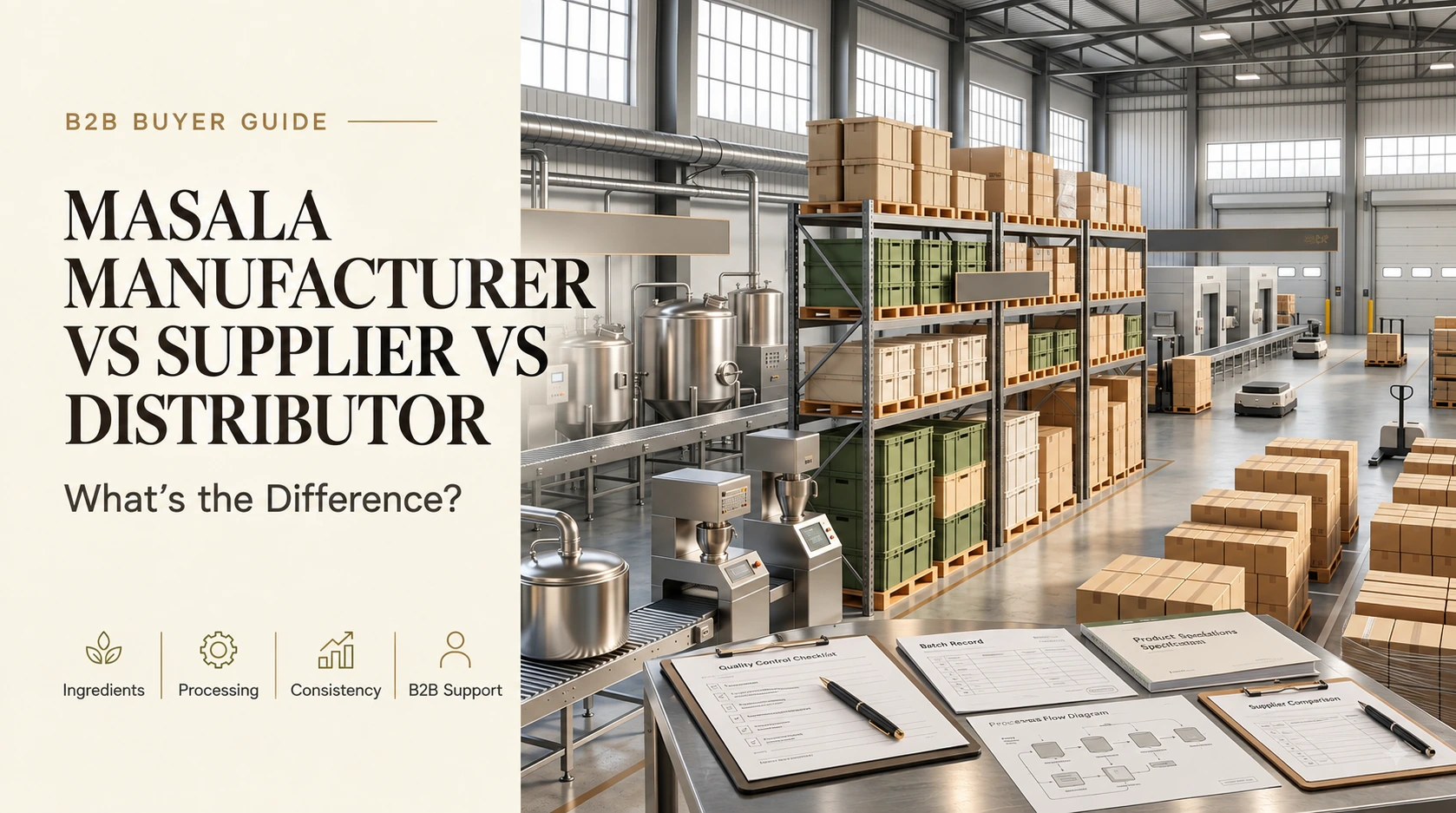
When a restaurant, retailer, hotel, caterer or food business searches for a masala manufacturer Chennai partner or a masala supplier Chennai contact, the terms can sound interchangeable. They are not. A manufacturer makes or processes the masala, a supplier arranges products for business buyers, and a distributor moves products through a wider channel. Understanding the difference helps you ask better questions, compare the right options and choose a relationship that fits your purchasing needs.
Quick answer: manufacturer, supplier and distributor are different roles
A masala manufacturer produces, processes, blends or packs spice products under its own operation or brand. A masala supplier is a business-facing source that provides products to a buyer; it may supply its own manufactured range or arrange products from another producer. A distributor purchases or handles products for resale to retailers, food-service buyers or other trade customers, usually with a focus on territory, stock movement and delivery. One company can perform more than one role, so the label alone is not enough. Ask who makes the product, who owns the customer relationship and who is responsible for fulfilment.
For a Chennai buyer, contact a manufacturer when production details and consistency are central; a supplier when you need a convenient business source; and a distributor when reach and regular movement across outlets matter most. Your best option depends on product range, pack size, ordering rhythm, delivery expectations and the communication you need.
What a masala manufacturer Chennai business actually does
A manufacturer is closest to the production stage. Its responsibilities can include selecting ingredients, cleaning or preparing whole spices, milling powders, developing blends, packing finished goods and maintaining an internal process for repeat batches. For a buyer, this role can make it easier to understand how a product is made and to discuss a range at the source rather than through several intermediaries.
HIPA Masala is an Indian spice brand owned and operated by HIPA Enterprises in Pallavaram, Chennai. Its product presentation includes pure single spice powders and traditional South Indian blends. HIPA states that its approach includes selected whole spices, controlled low-temperature milling, slow-roasting whole spices and lentils for blends, zero artificial dyes, chemical preservatives and synthetic flavour enhancers, and attention to batch consistency. These are HIPA’s stated practices; buyers should discuss the product and documentation requirements relevant to their own business. HIPA describes formats from household packs through 500g and 1kg institutional packs, with B2B support for retailers, supermarkets, distributors, restaurants, hotels and caterers.
What a masala supplier Chennai business provides
A supplier is the commercial link between a product range and the business that needs it. The supplier may be the manufacturer, a stockist, a trading business or another authorised channel. Its value is often convenience: one point of contact, a defined product list, business communication and an arrangement for supplying the quantities and formats the buyer needs.
When comparing a masala supplier Chennai option, do not stop at “wholesale supplier.” Clarify whether the supplier is the producer, where goods are sourced, which products are available and how the order will be handled. Ask for exact product names, pack sizes, applicable product information and the process for raising a repeat order. A supplier may be the best fit when you want direct access to a brand’s range without building a separate procurement network.
For example, a food-service buyer can review HIPA Masala’ full masala and spice powder range before discussing a business requirement. The listed range includes Sambar Powder, Rasam Powder, Turmeric Powder, Red Chilli Powder, Coriander Powder, Cumin Powder, Pepper Powder and Garam Masala. A retailer may be interested in household packs, while a restaurant or caterer may need institutional pack formats. Those are different buying conversations, even when the brand is the same.
How a distributor differs from a manufacturer or supplier
A distributor is primarily concerned with channel coverage. It may buy products from a manufacturer or supplier and resell them to retailers, restaurants, supermarkets, hotels, caterers or other trade accounts. Its strengths can include local market knowledge, a network of outlets, delivery coordination and the ability to combine products from different brands or categories.
Distribution can be useful when your business serves multiple locations or when you need a trade partner to manage regular movement. However, the distributor may not be the right person to answer detailed production questions. If ingredient selection, milling approach or blend method matters to your evaluation, ask to speak with the brand or manufacturer as well. If your priority is route coverage, stock availability and coordinated delivery, evaluate the distributor’s operating fit instead.
Comparison table for Chennai business buyers
| Role | Main responsibility | Best question to ask | Often useful for |
|---|---|---|---|
| Manufacturer | Makes, processes, blends or packs the product. | Who produces the masala, and what product and pack options are available? | Buyers who want source-level product understanding and a direct brand conversation. |
| Supplier | Provides products to a business buyer through a commercial supply arrangement. | Are you the producer or a sourcing channel, and how will repeat orders be handled? | Retailers, food businesses and institutions seeking a convenient business source. |
| Distributor | Moves products through a territory or resale network. | Which outlets or areas do you serve, and how is replenishment coordinated? | Businesses needing channel reach, multi-location movement or trade coverage. |
Choosing a masala manufacturer Chennai or masala supplier Chennai partner
Start with the job your business needs the partner to do. A restaurant may care about dependable flavour across repeated cooking, suitable institutional packs and a clear contact for replenishment. A supermarket may care about consumer-facing pack options and a range that can sit alongside other grocery products. A caterer may need to plan larger cooking cycles, while a distributor may evaluate the range from a resale and territory perspective. There is no universal “best” channel; there is only a better fit for the operating requirement.
Buyer checklist before placing an enquiry
- Identify the role: Ask whether you are speaking to the manufacturer, a direct supplier or a distributor.
- Confirm the range: Match the products to your menu, shelf plan or customer demand. HIPA provides dedicated information for Sambar Powder and Rasam Powder, two traditional South Indian blend categories.
- Review pack suitability: Compare household packs with the stated 500g and 1kg institutional formats where relevant to your operation.
- Ask about process: If production approach matters, ask the brand to explain its stated handling of whole spices, milling, roasting and blend preparation.
- Plan replenishment: Establish who receives repeat orders and how you will communicate changes in quantity, location or product mix.
- Keep the evaluation proportionate: Request only the product, commercial and business information needed for your decision; do not assume a channel role proves performance on its own.
Understanding the HIPA Masala range for business use
HIPA Masala presents a focused range that can suit different parts of a commercial kitchen or retail assortment. Single spice powders include Turmeric Powder, Red Chilli Powder, Coriander Powder, Cumin Powder and Pepper Powder. The blend range also includes Garam Masala. For a buyer, separating everyday single spices from recipe-oriented blends can make it easier to map products to kitchen use, shelf placement or a distributor’s assortment.
Common mistakes when comparing these three channels
- Comparing different roles as if they were identical: A manufacturer’s production discussion, a supplier’s ordering discussion and a distributor’s route discussion answer different questions.
- Assuming “direct” explains everything: Direct contact is useful, but you still need clarity on products, packs, ordering and the person responsible for follow-up.
- Choosing only by the lowest quoted figure: A commercial comparison should also consider the fit between pack size, replenishment process, communication and intended use.
- Skipping the business brief: A clear description of your outlet type, location and requirement helps the other party respond more usefully.
FAQ: masala manufacturer and supplier questions
Is every masala supplier also a manufacturer?
No. Some suppliers manufacture their own range; others source and provide products made by another business. Ask directly who produces the product and who will manage your account.
Should a restaurant buy from a manufacturer or distributor?
Either can work. A manufacturer may suit a restaurant that wants a direct brand conversation, while a distributor may suit a business that values route coverage or consolidated trade supply. Compare the actual operating fit.
Can one company be both a manufacturer and supplier?
Yes. A brand can make products and supply them directly to business buyers, while also working with distributors for broader market access. Confirm which channel you are using for your enquiry.
How do I start a HIPA Masala business enquiry?
Use the HIPA Masala B2B enquiry page and explain your business type, product interest, pack requirement and location. HIPA Enterprises lists its address in Pallavaram, Chennai, and provides a contact page for further communication.
Make the right distinction before you buy
The difference between a manufacturer, supplier and distributor is fundamentally about responsibility: who makes the masala, who supplies it to your business and who moves it through a resale or delivery network. For Chennai and Tamil Nadu buyers, defining that responsibility early can make sourcing clearer and reduce avoidable back-and-forth. If you are evaluating a masala manufacturer Chennai or masala supplier Chennai option, learn about HIPA Masala and HIPA Enterprises, review the range, and then share your requirement through the HIPA Masala website. A specific business brief is the best next step toward a practical conversation.