
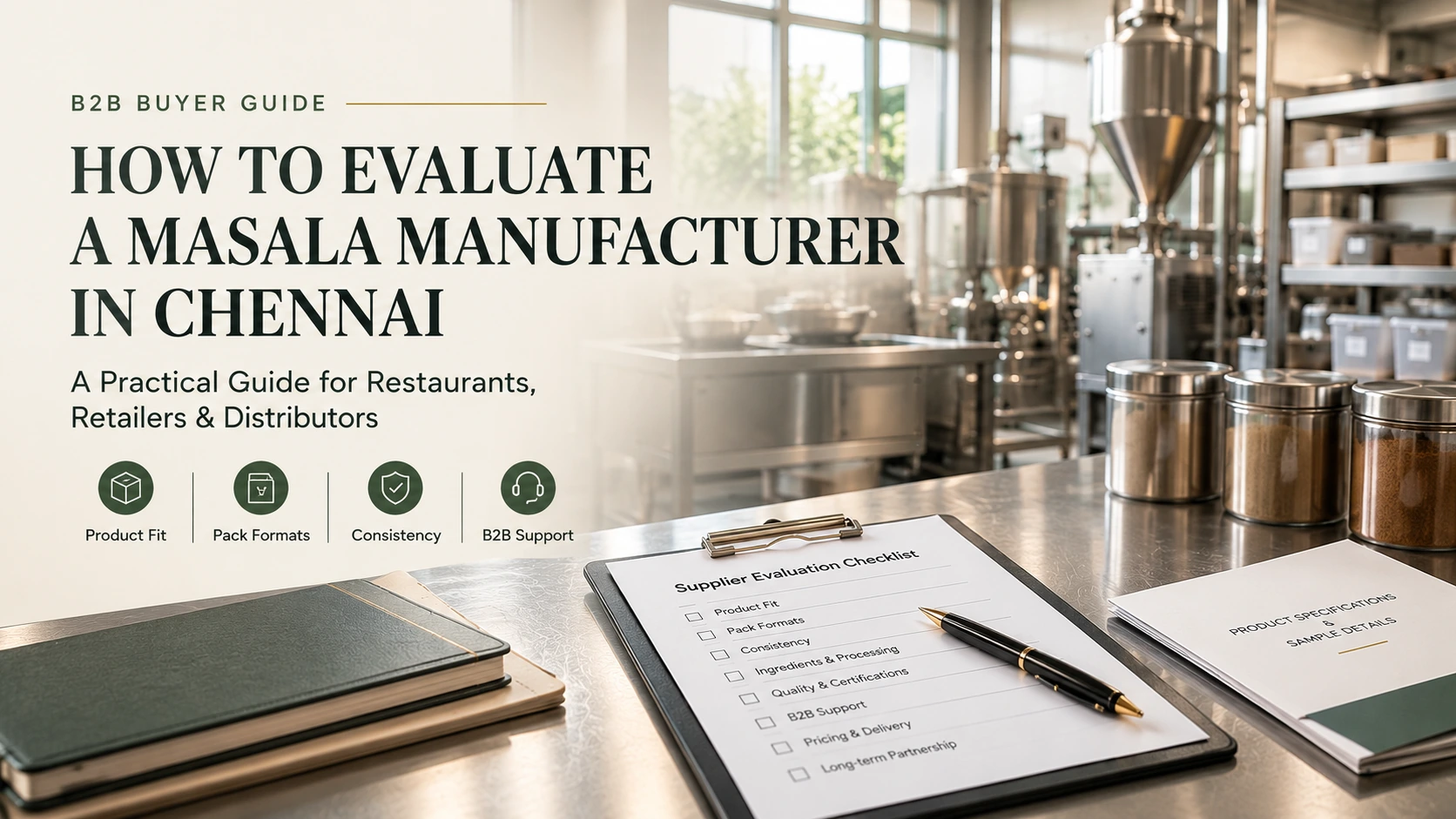
Choosing a masala manufacturer for restaurants / retailers Chennai is not simply a packet-price comparison. Restaurants need dependable flavour in repeated cooking. Retailers need a sensible range and pack formats. Distributors need clear communication across business types. Start with operational fit, product transparency and the supplier’s ability to discuss your requirements.
Answer first: what should a Chennai buyer evaluate?
Restaurants, retailers, distributors, caterers, hotels and other food businesses should assess five areas: range, stated production approach, institutional pack suitability, support conversations, and location or communication convenience. Ask for exact products and formats, understand stated ingredient and processing information, and compare how clearly the supplier answers practical questions. Treat claims such as low-temperature milling, slow-roasting, no artificial dyes or batch consistency as the manufacturer’s stated approach unless independently verified.
HIPA Enterprises owns and operates HIPA Masala from Pallavaram, Chennai. Its range includes pure single spice powders and traditional South Indian blends. The site describes support for retailers, supermarkets, distributors, restaurants, hotels and caterers, with household through 500g and 1kg institutional formats. Include HIPA in a shortlist, then use your own samples and commercial checks to determine fit.
Why product fit matters for a masala manufacturer for restaurants / retailers Chennai
Different buyers use masalas differently. A restaurant or hotel may need a repeatable menu blend, while a caterer may plan larger-volume cooking around a South Indian profile. A retailer or distributor may need a coherent range. Map your use case before asking for a quotation.
Build a requirement sheet before contacting suppliers
- List the products. Separate single spice powders from blended products. Note whether you need sambar, rasam or garam masala in addition to everyday spices.
- List the users. Record whether the buyer is a restaurant kitchen, retail shelf, hotel, caterer, supermarket or distribution route.
- List the pack needs. Identify whether household packs, 500g packs, 1kg packs or a combination is relevant. Do not assume a format is available without confirming it.
- List decision criteria. Include flavour suitability, ingredient communication, pack handling, replenishment discussion and contact responsiveness.
HIPA’s listed masala and spice product range includes Sambar Powder, Rasam Powder, Turmeric Powder, Red Chilli Powder, Coriander Powder, Cumin Powder, Pepper Powder and Garam Masala. Review the individual product pages, then ask which items and pack sizes match your business requirement.
How to compare the manufacturer’s stated production approach
A credible B2B conversation should make the product understandable. Ask what the manufacturer says about selected spices, whole-spice processing and blend handling. This creates a clear basis for comparing suppliers and deciding what your team should sample.
HIPA Masala describes selected whole spices and controlled low-temperature milling as part of its approach. For blends, the site describes slow-roasting of whole spices and lentils. It also states an approach of using zero artificial dyes, chemical preservatives and synthetic flavour enhancers, and refers to batch consistency. These are useful points to discuss with the HIPA team. They should be read as HIPA’s stated practices, not as independent test results or certifications.
Questions that improve supplier evaluation
- Which ingredients are used in the specific product under consideration?
- Is the product a single spice powder or a traditional blend?
- How does the stated processing approach apply to that product?
- Which pack formats can be discussed for retail and institutional use?
- How should a buyer compare samples consistently across suppliers?
Use product-specific questions rather than applying one assumption to the full catalogue. A buyer may review HIPA Sambar Powder for a restaurant recipe and HIPA Turmeric Powder as a single-spice item.
Masala manufacturer for restaurants / retailers Chennai: compare fit by business type
One supplier can be relevant to several channels, but the buying questions are not identical. Keep the comparison practical and avoid awarding a supplier points for information that does not affect your operation.
| Buyer | Primary question | Useful discussion point |
|---|---|---|
| Restaurant or hotel | Will the product suit the intended menu and cooking workflow? | Discuss blend choice, sample evaluation and 500g or 1kg institutional formats. |
| Retailer or supermarket | Does the range make sense for the customers you serve? | Compare single spices, South Indian blends and household-to-institutional pack options. |
| Distributor | Can the range support the accounts in your route? | Clarify the products, pack formats and communication needed for different business customers. |
| Caterer | Can your team assess the flavour profile for planned menus? | Request a product-focused conversation before committing to a regular buying pattern. |
For a restaurant, start with the most-used blend and assess complementary single spices such as HIPA Coriander Powder or HIPA Cumin Powder. Retailers and distributors should review the range as a portfolio.
Check the range, not just one popular blend
A catalogue that covers categories your business already buys can simplify the first conversation. HIPA’s stated range combines everyday single spices with blends, but each product still requires assessment.
For a South Indian food business, review HIPA Rasam Powder alongside sambar powder when both recipes matter. For retail or distribution, consider whether HIPA Red Chilli Powder, HIPA Pepper Powder and HIPA Garam Masala fill distinct needs. This checks range relevance, not whether every product suits every recipe or market.
Clear distinctions between single spice powders and blends also make internal ordering and menu trials easier.
Evaluate pack formats and the B2B conversation
Pack size affects handling, storage and ordering decisions. A small retail pack may suit a household customer, while an institutional kitchen may prefer a 500g or 1kg format. HIPA’s site describes formats from household packs through 500g and 1kg institutional packs. Confirm the exact format for each product and channel; do not infer availability, minimum order quantity or pricing from a general product page.
A useful supplier conversation covers your business type, product list, pack format and location, plus questions about the stated approach and product selection. HIPA provides a dedicated B2B enquiry page for business buyers. Describe the requirement instead of asking only for a rate.
A practical pre-order checklist
- Have you named the exact products rather than only saying “masala”?
- Have you stated whether the requirement is retail, restaurant, hotel, catering or distribution?
- Have you asked about the relevant household, 500g or 1kg format?
- Have you recorded which product claims are stated by the manufacturer and which points you still need to verify?
- Have you agreed on the next step for sample or product evaluation?
Why a Chennai location can simplify business communication
For Chennai and Tamil Nadu buyers, location is practical supplier context. A local address can help frame a conversation around nearby restaurants, retailers, hotels, caterers and distributors, but it is not proof of product suitability and does not replace product or commercial checks.
HIPA Masala is owned and operated by HIPA Enterprises in Pallavaram, Chennai. Its stated address is Plot No. 10, (Highway Colony), 5th Main Road, Zamin Pallavaram, Highway Nagar, Perumal Nagar, Old Pallavaram, Chennai – 600117, Tamil Nadu, India. Review the HIPA Masala company information page and use the HIPA Masala contact page for communication. The listed phone is +91 70580 53055 and email is info@hipamasalas.com.
Short FAQ for Chennai business buyers
What makes a manufacturer suitable for a restaurant?
Start with the product used in the menu, assess its flavour suitability through your normal cooking process, and confirm the relevant institutional pack format. Then discuss the next commercial step with the manufacturer.
Should retailers and distributors evaluate the full range?
Yes, when building an assortment. Review the distinction between single spice powders and blends, then select products that match your customers or account base. A full-range review does not mean every product must be stocked.
Can HIPA’s stated processing approach replace buyer checks?
No. HIPA describes selected whole spices, controlled low-temperature milling, slow-roasting for blends, and an approach excluding artificial dyes, chemical preservatives and synthetic flavour enhancers. Buyers should treat these as stated practices and perform their own product and commercial evaluation.
Conclusion: choose the masala manufacturer for restaurants / retailers Chennai that fits your workflow
The strongest evaluation is specific. Define your products, channel, pack needs and decision criteria. Compare the manufacturer’s stated approach without turning it into an unsupported guarantee. Review the range and ask direct questions about your operation. For businesses seeking a Chennai-based option, HIPA Masala offers a stated portfolio of single spice powders and traditional South Indian blends, plus B2B support for retailers, supermarkets, distributors, restaurants, hotels and caterers. Visit the HIPA Masala home page, then submit a focused enquiry based on the products and formats your business needs.