
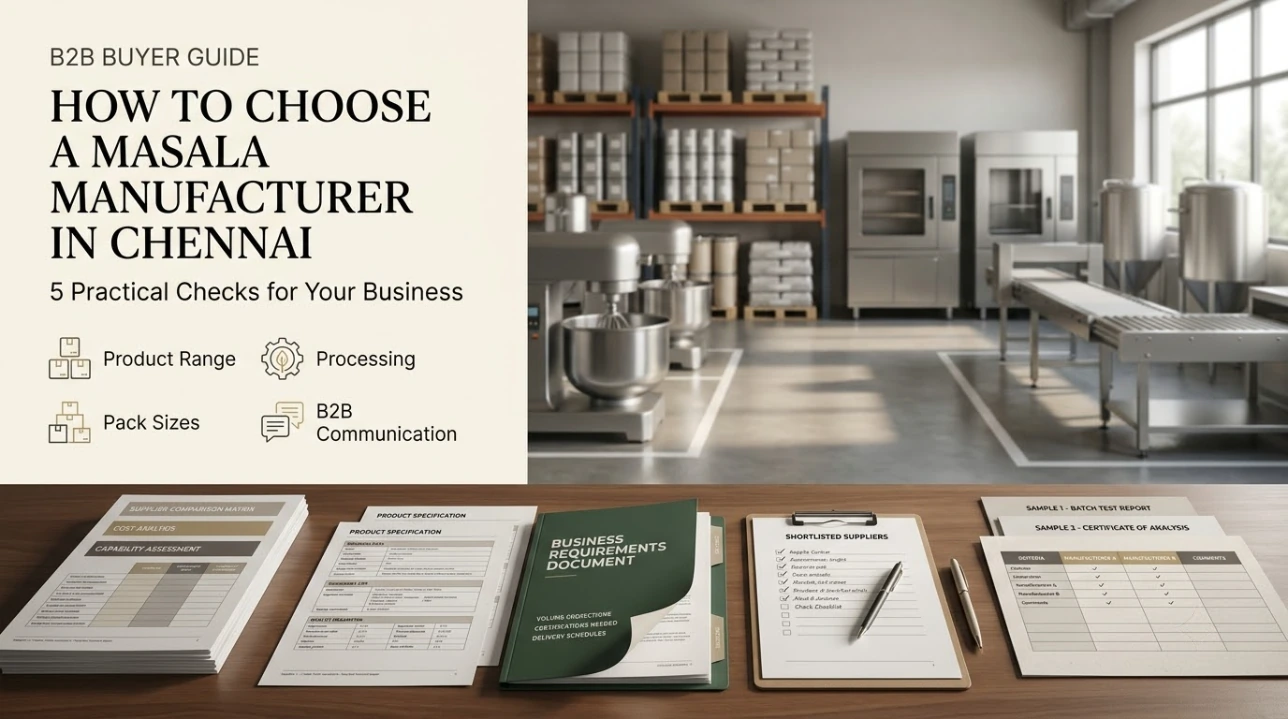
Choosing a masala manufacturer in Chennai is a commercial decision, not just a search for a spice powder supplier. Restaurants, retailers, distributors, caterers, hotels and other food businesses need a partner whose products, pack formats and communication fit the way they buy and operate.
Answer first: compare manufacturers on five practical points: the masala range you actually need, the stated approach to ingredient selection and processing, pack sizes for your sales or kitchen use, how the supplier addresses consistency, and how clearly the business handles B2B enquiries. Then ask for product and commercial details before making a purchase decision. This process helps a Chennai buyer assess suitability without relying on broad promises.
Why the right masala manufacturer in Chennai matters
A masala affects more than flavour. It can influence recipe preparation, menu consistency, stock planning and retail presentation. A restaurant may need everyday powders and blends, while a supermarket, distributor, hotel or caterer may prioritise a clear range, suitable pack formats or a responsive point of contact.
That is why the lowest quoted price or the largest-looking catalogue should not be the only filter. A more useful comparison asks whether the manufacturer is transparent about what it offers and whether the offer matches your business model.
How to choose a masala manufacturer in Chennai: five checks
1. Match the product range to your actual requirement
Start with your purchase list rather than a generic supplier search. Write down the powders and blends you use now, the products you plan to add, and whether you need single spices, traditional blends or both. This makes it easier to identify gaps and prevents you from selecting a supplier only because one product looks suitable.
HIPA Masala presents a range of pure single spice powders and traditional South Indian blends. Its listed products include Sambar Powder, Rasam Powder, Turmeric Powder, Red Chilli Powder, Coriander Powder, Cumin Powder, Pepper Powder and Garam Masala. You can review the masala product range first, then compare it with your purchase list.
| Business type | Useful first questions |
|---|---|
| Restaurant or hotel | Does the range cover the powders and blends used in core recipes? Are institutional pack formats described? |
| Retailer or supermarket | Can the range support a clear shelf selection of everyday spices and South Indian blends? |
| Distributor | Can you discuss the products and buying requirements directly with a B2B contact? |
| Caterer | Do the listed products and pack descriptions fit recurring menu and kitchen usage? |
2. Understand the stated ingredient and processing approach
Ask what the manufacturer says about raw materials and production. Useful discussion points include whole-spice selection, milling, roasting for blends and additives the brand says it avoids. These points do not replace procurement checks, but they help you compare suppliers on more than appearance or price.
HIPA Masala describes an approach based on selected whole spices and controlled low-temperature milling. For its blends, the site describes slow-roasting whole spices and lentils. It also states that the products use zero artificial dyes, chemical preservatives and synthetic flavour enhancers. These are HIPA's stated practices and positioning; a business buyer should still review the product information and agree any required checks before ordering.
For a focused review, see the pages for Turmeric Powder, Red Chilli Powder, Coriander Powder, Cumin Powder and Pepper Powder. For blend requirements, review Sambar Powder, Rasam Powder and Garam Masala.
3. Check pack formats against your buying pattern
Pack size should follow your operation. A retailer may need household packs for its shelf. A restaurant, hotel or caterer may assess larger institutional packs to simplify kitchen replenishment. A distributor may need to understand which formats are intended for which customer segment.
The HIPA Masala site describes product formats ranging from household packs through 500g and 1kg institutional packs. Treat this as a starting point for your enquiry: confirm the specific product, pack size and commercial availability that apply to your requirement. Avoid assuming that every listed product is offered in every format.
4. Look for a clear conversation about consistency
Food businesses often care about repeatability because a change in a blend can affect recipes, customer expectations or staff instructions. Ask how the manufacturer describes batch consistency and what product information is available for review. Keep the question specific: you are assessing process and communication, not seeking an absolute guarantee.
HIPA Masala describes batch consistency as part of its approach. Use that statement to frame follow-up questions about the products and formats under consideration, and record the answers for a fair comparison.
5. Test the quality of B2B communication
A practical supplier relationship depends on clear exchanges. In your first message, explain whether you are a restaurant, retailer, distributor, caterer, hotel or another food business. List the products you are considering, the pack sizes you want to discuss and the location or buying context. A clear brief helps the manufacturer respond to the actual requirement.
HIPA Masala states that it supports retailers, supermarkets, distributors, restaurants, hotels and caterers. Its B2B enquiry page is the appropriate starting point. Assess whether the response answers your questions and identifies the next step.
Comparison checklist for Chennai and Tamil Nadu buyers
Use this checklist when comparing a masala manufacturer in Chennai with other options. It is practical and does not assume that one supplier suits every business.
- Range: Mark the exact powders and blends you need, and note any missing items.
- Processing: Record the manufacturer's stated approach to whole spices, milling, roasting and additives.
- Formats: Match household, 500g or 1kg institutional descriptions to your sales or kitchen workflow.
- Consistency: Ask what the brand means by batch consistency and what information can be shared for review.
- Fit: Separate requirements for retail shelves, distribution, food-service kitchens and catering operations.
- Communication: Keep a written record of product, pack and enquiry details so that quotations or next steps are comparable.
- Location: Consider whether a Chennai-based conversation is convenient for your business, while still confirming the commercial details that matter.
Why HIPA Masala may be worth adding to your shortlist
HIPA Masala is an Indian spice brand owned and operated by HIPA Enterprises in Pallavaram, Chennai. The brand presents pure single spice powders alongside traditional South Indian blends, which can be relevant when a business wants to review everyday spices and familiar menu blends through one supplier conversation.
Its stated product approach includes selected whole spices, controlled low-temperature milling and slow-roasting of whole spices and lentils for blends. HIPA also states that it avoids artificial dyes, chemical preservatives and synthetic flavour enhancers, and describes batch consistency as part of its approach. These are the brand's stated practices, not independently verified claims; use them to frame questions and confirm details relevant to your procurement process.
Read the about HIPA Masala page for business context, or visit the HIPA Masala home page for general information. Then review the products that match your menu, shelf or distribution plan.
Questions to ask before placing a business enquiry
Prepare these questions before contacting any manufacturer:
- Which products in the current range match my required powders and blends?
- Which pack formats are described for household and institutional use?
- What is the stated approach to whole spices, milling and roasting for the products I am reviewing?
- How does the brand describe batch consistency?
- What product and commercial details should I provide so the enquiry can be assessed accurately?
- Who should handle follow-up questions from my procurement, store or kitchen team?
FAQ: choosing a masala manufacturer in Chennai
What should a restaurant check first?
Begin with the powders and blends used in your core recipes. Then compare the stated processing approach, the pack formats described for institutional use and the clarity of the B2B response. Your goal is a workable supply conversation, not a generic product list.
Are household packs suitable for every business?
Not necessarily. A retailer may consider household packs for shelf sales, while a restaurant, hotel or caterer may need a larger format for kitchen use. HIPA describes household packs through 500g and 1kg institutional packs, but you should confirm the format for each product before ordering.
How can a distributor compare two manufacturers fairly?
Use the same checklist for both: required products, stated ingredient and processing approach, pack formats, consistency discussion and B2B communication. Keep product-specific answers together so that a broad claim from one supplier is not compared with a detailed answer from another.
How do I contact HIPA Masala about a business requirement?
Use the B2B enquiry route with your business type, product list and pack questions. You can also use the HIPA Masala contact page. The listed business address is Plot No. 10, (Highway Colony), 5th Main Road, Zamin Pallavaram, Highway Nagar, Perumal Nagar, Old Pallavaram, Chennai – 600117, Tamil Nadu, India. The listed phone is +91 70580 53055 and the email is info@hipamasalas.com.
Make your shortlist with the right questions
The best masala manufacturer in Chennai for your business is the one that fits your product requirement, operating format and procurement conversation. Compare the range you need, understand the manufacturer's stated approach, check the pack descriptions, ask precise questions about consistency and evaluate the quality of the response. If HIPA Masala matches those requirements, send a structured B2B enquiry so the next discussion can focus on your business rather than guesswork.